stackai whitepaper
AI Agents for Health Systems, Academic Medical Centers, and Community-Based Clinics
How hospitals, faculty practice plans, and community health centers are deploying governed AI agents around the EHR, not through it, to relieve administrative load without touching the system of record.
A practical guide for CIOs, CMIOs, CTOs, VPs of Operations, and Compliance and Revenue leaders evaluating enterprise AI agent platforms.





Health systems, academic medical centers, and community-based clinics share a hard truth: the administrative and operational burden around care has grown faster than the workforce, and the EHR is not the place to solve it. Epic, Oracle Health, and the rest are systems of record, not automation engines, and every integration into them is a slow, IT- gated, instance-specific project.
The opportunity is to deploy governed AI agents around that system of record: on the access center, the patient portal, the knowledge base, the intake queue, and the eligibility and prior-auth front door. These are high-volume, high-friction workflows that rarely require deep read or write access to Epic, and where an agent with the right guardrails delivers measurable relief in weeks rather than quarters.
This whitepaper lays out five use cases proven in enterprise and academic settings, including a clinical triage and evaluation pipeline built at a leading academic medical center. It addresses head-on the concerns every health-system buyer raises: EHR integration reality, data residency and on-premise control, clinical governance and hallucination, and why a governed orchestration layer succeeds where Microsoft Copilot Studio runs out of room.
The systems that adopt this posture will free clinical and operational staff for the work that requires them, with an auditable trail for every automated action.
The published research is consistent: clinicians and staff spend a large and growing share of their time on documentation, messaging, prior authorization, and coordination rather than on patients. In a health system that burden is distributed across the access center, the coding and revenue-integrity teams, care coordination, compliance, and the clinicians themselves.
The instinct is to ask the EHR vendor to fix it. But three realities get in the way:
– The EHR is a system of record, optimized for storing and retrieving the chart, not for orchestrating cross-system workflows or making judgment calls.
– Every integration is an instance-specific IT project. Even two organizations on the same Epic build have different endpoints, preferences, and data structures, so there is no single reusable connector, and lead times of twelve weeks or more are normal.
– Vendor AI add-ons are tied to a single ecosystem and a single model, with limited configurability and no independent governance layer.
The systems getting meaningful leverage deploy a governed agent layer around the EHR instead of waiting for it to become an automation platform.
The EHR is not an automation engine
The highest-ROl agent workflows live around the chart, not inside it: access center, portal, intake, knowledge base, eligibility. A platform that assumes deep EHR write access will sit in your IT queue.
Data residency is nonnegotiable
AMCs and many systems require that PHI never leave their environment. The platform must run single-tenant or fully on-premise, with your own models and a specific cloud region, so residency commitments are enforceable rather than aspirational.
Clinical governance is the gating factor
Nothing consequential ships without review. Human-in-the-loop, citations, evaluator scoring, and a complete audit trail are prerequisites, not features.
No vendor conflict of interest
An orchestration layer is not trying to sell you more cloud, more licenses, or more of one model family. That neutrality matters when the workflow spans Epic, Microsoft, Google, and homegrown systems.
Buy the platform, own the workflows
Subject-matter experts in revenue integrity, access, and compliance should be able to build and change agents themselves, without a professional-services engagement for every edit.
Classifies inbound patient messages and intake responses by urgency and clinical category, routes to the right pathway, and scores every triage against a clinical rubric.
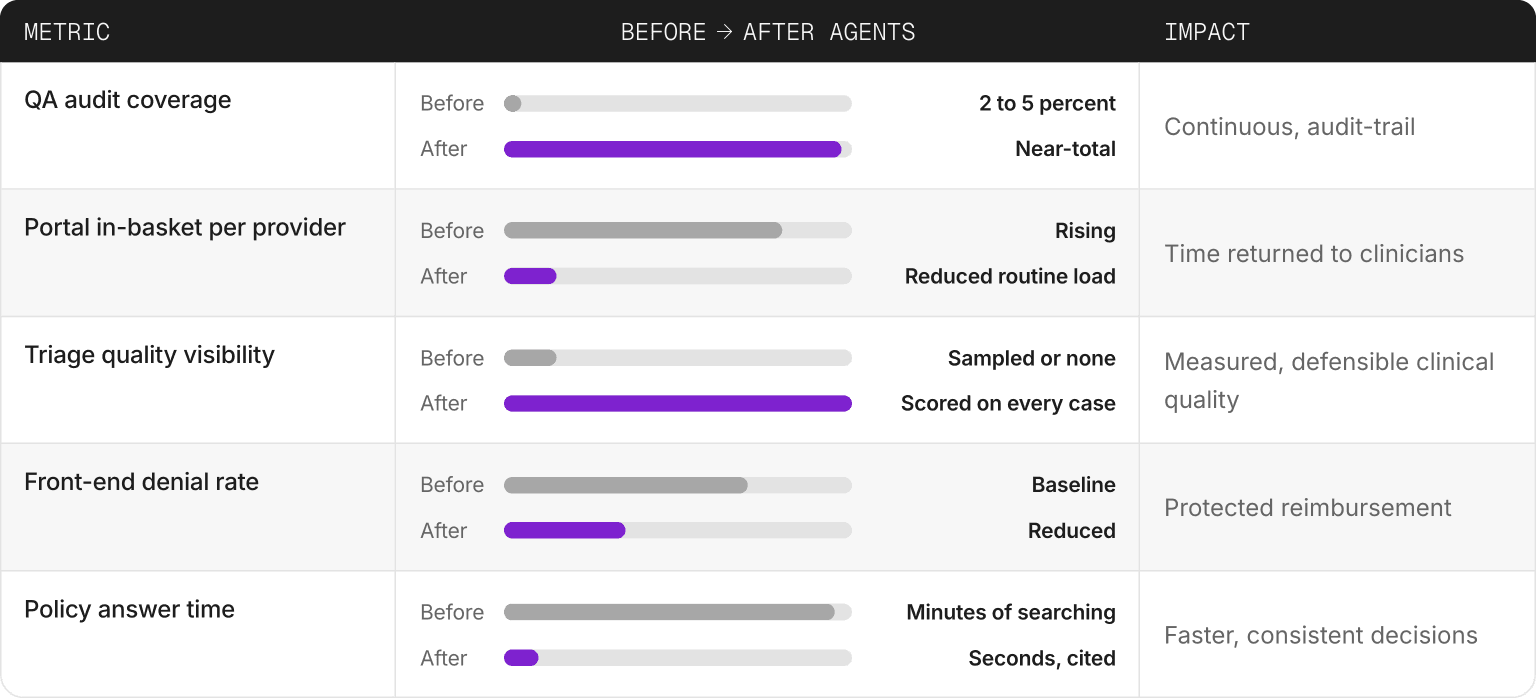
Near-total audit coverage of access-center calls and messages against HIPAA, consent, script, and quality standards.
Sourced, cited answers for clinical and operational staff across SOPs, protocols, formulary, and state and federal regulation.
Classifies portal messages and drafts responses for staff review, cutting the in-basket load.
Verifies eligibility, extracts coverage from insurance cards, and assembles prior-auth packets before the visit.
The Problem
Inbound patient messages and intake responses arrive faster than staff can triage them, and the cost of getting urgency wrong is high. Manual triage is slow, inconsistent between staff, and invisible to quality review.
How An AI Agent Handles It
An agent ingests an inbound message or intake response, classifies urgency and clinical category, and routes it to the appropriate care pathway. An evaluator loop scores every triage decision against the organization's own clinical rubric, so accuracy is measured continuously rather than assumed. This is the exact shape of pipeline built at a leading academic medical center as its first evaluation of agentic AI in clinical intake, deliberately deployed in a demo-and-evaluator posture first, with a documented path to expand into intake automation and provider-facing triage aids as confidence grows.
Why It Matters
Triage is where AI in a clinical setting has to earn trust, so it is the right place to prove the governance model: measured accuracy, cited reasoning, and a human reviewing anything the agent is not fully confident about, before autonomy is ever extended.
CMIO, VP Clinical Operations, Access Center leadership, Quality
Triage accuracy against rubric, response time, escalation appropriateness
Faster routing, measured and auditable triage quality, a governed path from evaluation to production
The Problem
Access centers and patient-facing teams handle enormous call and message volume subject to HIPAA, consent requirements, and internal quality standards. Manual QA reaches only a few percent of interactions, leaving the vast majority unreviewed.
How An AI Agent Handles It
An agent reviews every call transcript, chat, and message against a structured rubric: identity verification and minimum-necessary standards, consent and disclosure, script and protocol adherence, resolution and tone, and escalation appropriateness, plus sentiment and safety-signal detection. Results roll up by agent, team, and channel, and flag failing interactions for human QA. The same shape extends to voice-agent calls, which are summarized into structured intent and QA records.
Why It Matters
Coverage moves from a sampled few percent to near-total, at a cost that scales sub-linearly with volume, turning QA from a spot-check into a continuous, audit-ready trail and reducing regulatory exposure.
VP Patient Access, Compliance, Quality, Revenue Integrity
Percent of interactions audited, issue-detection rate, escalation accuracy
Near-total audit coverage, earlier detection of systemic issues, defensible audit trail
The Problem
Frontline clinical and operational staff burn time hunting through SOPs, protocols, formulary, payer rules, and constantly changing state and federal regulation. Answers are inconsistent, and tribal knowledge walks out the door with turnover.
How An AI Agent Handles It
A retrieval-based assistant answers natural-language questions across the internal knowledge base with verbatim citations back to the source document and section. A regulation-parser subflow keeps the knowledge base in sync with the latest published state and federal updates, so answers do not drift from current rule. Companion collector workflows capture new answers from senior staff and add them to the base, so coverage improves without a dedicated knowledge-management team.
Why It Matters
For a community-based clinic or an academic practice navigating HRSA, HCBS, state Medicaid, and payer-specific rules, a cited, always-current policy assistant is both a productivity tool and a compliance control.
Clinical operations, compliance, revenue integrity, care coordination
Time-to-answer, answer consistency, policy-currency, onboarding ramp
Faster, consistent, cited answers, reduced dependence on tribal knowledge
The Problem
The patient portal in-basket has become one of the heaviest hidden burdens in a health system, and much of it is administrative rather than clinical.
How An AI Agent Handles It
A classifier reads every inbound portal message and routes it (scheduling, refill, billing, clinical, escalation). A draft-reply agent pulls the relevant context and drafts a response for the appropriate staff member or provider to review and send, with clinical guardrails and escalation criteria built in. Administrative messages resolve fast, clinical ones arrive at the provider pre-summarized.
Why It Matters
Portal burden is a documented driver of clinician burnout. Cutting the routine load, while keeping a human on anything clinical, returns time to the people who need it most.
Ambulatory operations, clinic managers, CMIO
In-basket volume per provider, response time, staff time per message
Routine messages deflected or pre-drafted, clinical messages arrive summarized, faster turnaround
The Problem
Coverage errors and missing authorizations discovered after the visit are a leading cause of denials and write-offs, and for community-based clinics and safety-net providers the margin to absorb them is thin.
How An AI Agent Handles It
At the front door, an agent verifies eligibility in real time and extracts a structured coverage record from an uploaded insurance card or PDF (payer, member ID, group, plan, copay, deductible), writing it to the chart so downstream billing works from clean data. For services that need authorization, the agent assembles the prior-auth packet from the record against payer requirements and routes it for review. A companion clinical-eligibility validator checks program-specific rules and returns a pass, flag, or hold with the rule cited.
Why It Matters
Catching coverage and authorization issues before the visit converts a downstream denial into a non-event, and for a grant- or Medicaid-funded organization, that revenue integrity is existential.
Revenue Integrity, Patient Access, community-based clinic finance leadership
Clean-coverage rate, prior-auth turnaround, front-end denial rate
Fewer denials from bad coverage data, faster authorizations, protected reimbursement
Set It in Production
Three of these workflows, built and running on StackAI today.
An intake orchestrator runs eligibility, provider matching, and scheduling as subflow tools, turning a patient's first message into a structured, routed intake and a booked appointment.
StackAI - workflow canvas

The build: one orchestrator calls eligibility, provider-match, and scheduling subflows from a single conversation.
app.stackai.com

The surface: a patient is guided from first message to a booked first appointment.
Call transcripts are analyzed against a compliance rulebook, producing a QA summary, a pass-or- fail status, a Teams alert on non-compliant calls, and a full compliance report.
StackAI - workflow canvas

The build: transcripts and metadata feed a compliance analyzer and QA summary, then route alerts and a report.
A training assistant answers staff questions only from the uploaded documents, always citing the source, and a lesson generator turns a topic into a short lesson with objectives, steps, and a practice task.
StackAI - template

The build: a question or topic routes to a cited training-QA agent or a lesson generator, both bound to the uploaded documents.
"We are on Epic. Can you even integrate, and how long will it take?"
"Our PHI cannot leave our environment. Can you run on-premise?"
"How do we govern this clinically, and prevent hallucination?"
"We are a Microsoft shop. Why not Copilot Studio?"
"How is this priced, and how do we prove ROl before committing?"
Access-center and QA monitoring is the governance foundation that lets you deploy
clinical-adjacent agents with confidence.
The knowledge and policy assistant makes every other workflow more accurate,
because the same cited, current source of truth grounds triage, portal replies, and
eligibility rules.
Triage and portal management relieve the two heaviest sources of frontline and
clinician burden.
The eligibility and prior-auth front door protects revenue and feeds clean data into
everything downstream.
The result is administrative relief around the EHR, delivered in weeks, with a measured and auditable trail for every automated action.
Secure deployment on your cloud or StackAI's, in the region you choose, with your own models. PHI never leaves your environment.
Orchestrates access center, portal, knowledge base, and eligibility without requiring deep Epic write access.
Human-in-the-loop, citations, evaluator scoring, and complete audit logging on every workflow.
Model-agnostic with fallback, no conflict of interest with your cloud or EHR vendor.
Revenue-integrity, access, and compliance experts build and change agents without an engineering ticket.
500+ integrations across the Microsoft, Google, Epic, and homegrown systems you already run.