stackai whitepaper
AI Agents for Healthcare
Finance, Revenue Cycle,
and Claims Operations
How providers and payers are deploying AI agents across denials, eligibility, documentation, and post-visit reporting to recover revenue that is currently written off, with the accuracy controls and audit trail that revenue leaders demand.
A practical guide for VPs of Revenue Cycle, CFOs, Directors of Coding and Compliance, and Billing Operations leaders.





Revenue cycle is where healthcare loses money it has already earned. Claims are denied for fixable reasons and never reworked. Documentation misses a payer-specific element and a clean service becomes an uncollectible one sixty days later. Eligibility is wrong at the front door and the denial is baked in before the visit happens. Post-visit reporting to Medicaid is late or inaccurate and reimbursement slips.
The common thread is that this work is high-volume, rules-based, and judgment-heavy in ways that punish both full automation and pure manual effort. AI agents change the economics, but only if they are built the way revenue leaders require: built on your own denial history and payer rules, checked by an evaluator and a human, and granted autonomy progressively as measured accuracy earns it.
This whitepaper covers seven use cases proven across telehealth, home health, and multi- facility operators: post-claim denial analysis and resolution, closed-loop denial processing, pre-bill documentation compliance, eligibility and coverage capture, post-visit reporting and claim accuracy, finance close and reconciliation, and authorization lookup across state portals. In one home-health branch alone the denial workflow addresses more than 2,000 denied claims a week, work that previously consumed three to four case managers for roughly 16 hours a week. The design principle throughout: recommend first, approve with one click, and only automate the well-understood cases once accuracy clears the threshold you set.
2,000+
Denied claims a week now worked on a single branch
16h/week
Of manual denial rework taken off 3-4 case managers
96% +
First-pass notes compliance after pre-bill review
55,000 +
Compliance audits run a week in production
Every revenue cycle leaks at four predictable points.
- Denials that never get worked. Denied claims pile up faster than staff can rework them, so a large share age out unrecovered. Each one has a specific, often fixable reason, but finding it, pulling the supporting documents, and filing the correction is slow manual work.
- Documentation that fails after the fact. A note is clinically sound but missing a payer-required element (a measurable goal, a time stamp, a medical-necessity justification).
The claim goes out, gets denied two months later, and by then the encounter is impossible to reconstruct.
- Coverage errors at the front door. Wrong insurance on file, unverified eligibility, or a missing authorization means the denial is guaranteed before the visit even happens.
- Reporting that slips. For Medicaid-funded and facility-based operators, late or inaccurate post-visit reporting directly delays or reduces reimbursement.
This persists because the work does not scale with headcount, and the cost of an automated mistake in billing is high enough that most teams refuse to hand it to a black box. The fix is a governed agent with measured accuracy and a human in the loop.
Characteristic
A wrong code or a bad submission has financial and compliance consequences. The platform must support citations, evaluator scoring, and measurable accuracy before autonomy, not confident guessing.
Progressive autonomy
Revenue leaders will not flip a switch to full automation on day one. The platform has to support a staged path: recommend, approve, then auto-execute on well-understood cases, with the threshold under your crontrol.
Built on your rules
Denials, payer requirements, and documentation standards are specific to your payers and your history. Agents must be built on your own knowledge base, and improve as approvals feed back into it.
Payer portal and clearinghouse reach
The work lives in Availity, payer portals, and clearinghouse feeds. The platform needs API and browser-automation reach into those systems.
Defensible audit trail
Every coding decision, correction, and resubmission has to be logged and explainable for payer audit and internal compliance.
Pulls denied claims and their supporting documents,reads the denial reason against a knowledge base ofprior resolutions, and recommends a specificcorrective action.
Executes the approved resolution: files the correction, submits the appeal packet, or updates the record, with progressive autonomy.
Reviews every note against payer-specificrequirements before submission and returnsactionable feedback to the clinician.
Verifies eligibility and extracts a structured coveragerecord from insurance cards at the front door.
Turns visit and call records into accurate, timely Medicaid and facility reporting.
Generates budget-versus-actuals executive summaries per facility and reconciles AP and vendor statements.
Logs into state Medicaid and payer portals, captures authorization status and remaining units, and writes it back to the system of record.
The Problem
Denied claims arrive faster than staff can work them. Each denial requires pulling the claim, retrieving the specific supporting documents for that denial reason, understanding why it was denied, and deciding on a fix. At thousands of denials a week, most of the backlog ages out unrecovered.
How An AI Agent Handles It
On a schedule, the agent pulls the claim-status feed from the payer portal (for example the 276 feed from Availity), and for every denied claim it retrieves the supporting documents required for that denial reason via API. It reads the denial reason against a curated knowledge base of prior denial reasons and their resolutions, and recommends a specific corrective action: a corrected code, missing documentation, an appeal letter, or a resubmission path. The recommendation is routed to a case manager for one-click approval through Teams, Outlook, or a form, and the approval decision feeds back into the knowledge base so the model improves.
Why It Matters
In one home-health branch this addresses more than 2,000 denied claims a week, work that three to four case managers spent roughly 16 hours a week on. Recovering even a modest share of previously-aged-out denials is direct, measurable revenue.
VP Revenue Cycle, Denials Management, CFO
Denials worked per week, recovery rate, revenue recovered, hours saved
Backlog worked systematically, recovery on previously-abandoned denials, case- manager time returned
The Problem
A recommendation is only half the job. Someone still has to file the corrected claim, generate and submit the appeal packet, or update the record, and route each action to the right system.
How An AI Agent Handles It
This is the paired action layer. Once a case manager approves a recommendation (or once a case crosses the auto-approval threshold in later phases), the agent files the corrected claim, generates and submits the appeal packet, or updates the record, routing each action to the right downstream system. It is structured for progressive autonomy by design: it starts fully human-approved, then moves toward automatic execution on well-understood denial reason codes, with the accuracy threshold for autonomy set and controlled by you.
Why It Matters
Closing the loop is what turns "here is what to do" into recovered dollars without adding headcount, and the staged autonomy model is what makes revenue leaders comfortable letting it run.
Denials Management, Billing Operations, Compliance
Time-to-resolution, auto-resolution rate on eligible codes, appeal turnaround
Faster resolution, closed-loop recovery, autonomy that expands only as accuracy earns it
The Problem
A note that is clinically sound but missing a payer-required element becomes a denial after the claim is already out. By the time the denial arrives, the clinician has seen hundreds of patients and cannot reconstruct the encounter.
How An AI Agent Handles It
An agent reviews every completed note against a rules engine built from your payer-specific documentation requirements, in real time or as a nightly batch. It checks for required structural elements (measurable goals, baseline and progress), billing alignment (does the documentation support the CPT code, is time documented for time-based codes), and compliance flags (consents, telehealth attestations, patient location). Notes that pass are cleared for billing. Notes that fail are returned to the clinician with specific, actionable feedback rather than a vague denial two months later.
Why It Matters
Catching a documentation gap before submission converts a future denial into a non-event. At scale, even a small first-pass-clean-claim improvement compounds into significant monthly revenue protected, and clinicians get immediate feedback that improves their documentation over time.
VP RCM, Coding and Documentation, Compliance, Clinical Operations
First-pass clean-claim rate, denial rate, days in A/R, clinician rework
Notes-compliance rate rises into the high 90s, denials drop proportionally, faster revenue recognition
The Problem
Coverage errors at intake guarantee denials downstream. Manual eligibility checking and re-keying insurance cards is slow and error-prone, and "wrong insurance on file" is a leading root cause of avoidable denials.
How An AI Agent Handles It
At the front door the agent verifies eligibility in real time and extracts a structured coverage record from an uploaded insurance card or PDF via OCR and extraction (payer, member ID, group, plan, effective date, copay, deductible), writing it to the chart so downstream eligibility, benefits, and billing flows work from clean data. A companion clinical-eligibility validator checks program-specific rules where they apply.
Why It Matters
It removes a manual data-entry step at intake and cuts the coverage errors that drive denials weeks later, protecting revenue at the point where it is cheapest to protect.
Patient Access, Revenue Integrity, Front-End Operations
Clean-coverage rate, front-end denial rate, intake data-entry time
Fewer coverage-driven denials, faster intake, clean data feeding the whole revenue cycle
The Problem
For Medicaid-funded and facility-based operators, reimbursement depends on accurate, timely post-visit reporting. Done manually across dozens of facilities, it is late, inconsistent, and a source of both revenue slippage and compliance risk.
How An AI Agent Handles It
An agent turns visit and call records into structured, accurate post-visit and post-call reporting, applying the program's reporting rules, and routes exceptions for review. Deployed across a multi-facility footprint, it standardizes reporting so every facility reports the same way, on time, and flags the records that need a human before they go out.
Why It Matters
Accurate, timely reporting is the difference between full reimbursement and slippage, and acrossdozens of facilities the consistency alone materially reduces compliance exposure.
Revenue Cycle, Facility Operations, Compliance
Reporting timeliness, reporting accuracy, reimbursement realized
On-time, consistent reporting across facilities, protected reimbursement, reduced compliance risk
The Problem
Closing the books across a multi-facility network is a multi-day manual cycle: pulling GL data, computing variance, writing executive summaries by hand, and reconciling AP and vendor statements line by line.
How An AI Agent Handles It
Once AP and AR close each period, an agent connects to the ERP, pulls the GL data, computes variance against budget and prior period, and generates an executive-summary narrative tailored to the reader (facility administrator, regional VP, CFO), routing site-specific summaries to the right recipient. Companion flows produce standalone variance reports for controllers and flag unusual GL activity. On the AP side, a reconciliation agent ingests supplier statements each month, matches them line by line against internal records, and flags missing invoices, duplicate payments, and aging discrepancies, with row-level permissioning so each analyst sees only the vendors and facilities they are entitled to.
Why It Matters
It turns a multi-day close into same-day, consistent output across facilities, and gives leadershipcomparable financials without waiting on manual assembly.
CFO, Controllers, Facility Administrators, AP
Days to close, reconciliation exceptions caught, reporting consistency
Multi-day close becomes same-day, consistent per-facility reporting, faster exception review
The Problem
Care coordinators spend hours a day logging into state Medicaid and payer portals, one patient at a time, to check authorization status, remaining service units, and expiration dates. It is slow, it is easy to miss a lapse, and a missed authorization means unpaid care already delivered.
How An AI Agent Handles It
A browser-automation agent logs into the portals on the operator's behalf, navigates to the authorization screens, captures current status, units remaining, expiration dates, and pending actions, and returns a structured record for each patient. It runs the loop across the full patient list on a schedule and writes the extracted data back into the system of record (for example AlayaCare), so the care-management team works from one source of truth instead of portal after portal. Because this is all PHI, the workflow runs inside the operator's single-tenant environment with encrypted, bot-only access to portal credentials.
Why It Matters
It removes hours per day of manual portal work per coordinator and catches authorization lapses before care is delivered against an expired auth, which is one of the most preventable causes of unpaid work in home care.
VP Operations, Care Management, Revenue Cycle
Coordinator hours saved, authorization-lapse rate, unpaid-care avoidance
Hours per coordinator per day recovered, fewer lapsed authorizations, single source of truth
Set It in Production
Three of these workflows, built and running on StackAI today.
Eligibility, modifier, diagnosis-to-procedure, and documentation checks run in parallel, feed a risk assessment, and generate a specific fix list plus a Teams alert to the billing team before the claim is ever filed.
StackAI - workflow canvas

The build: six pre-submission checks converge on a risk assessment and task generator, then route a report and a Teams alert.
app.stackai.com
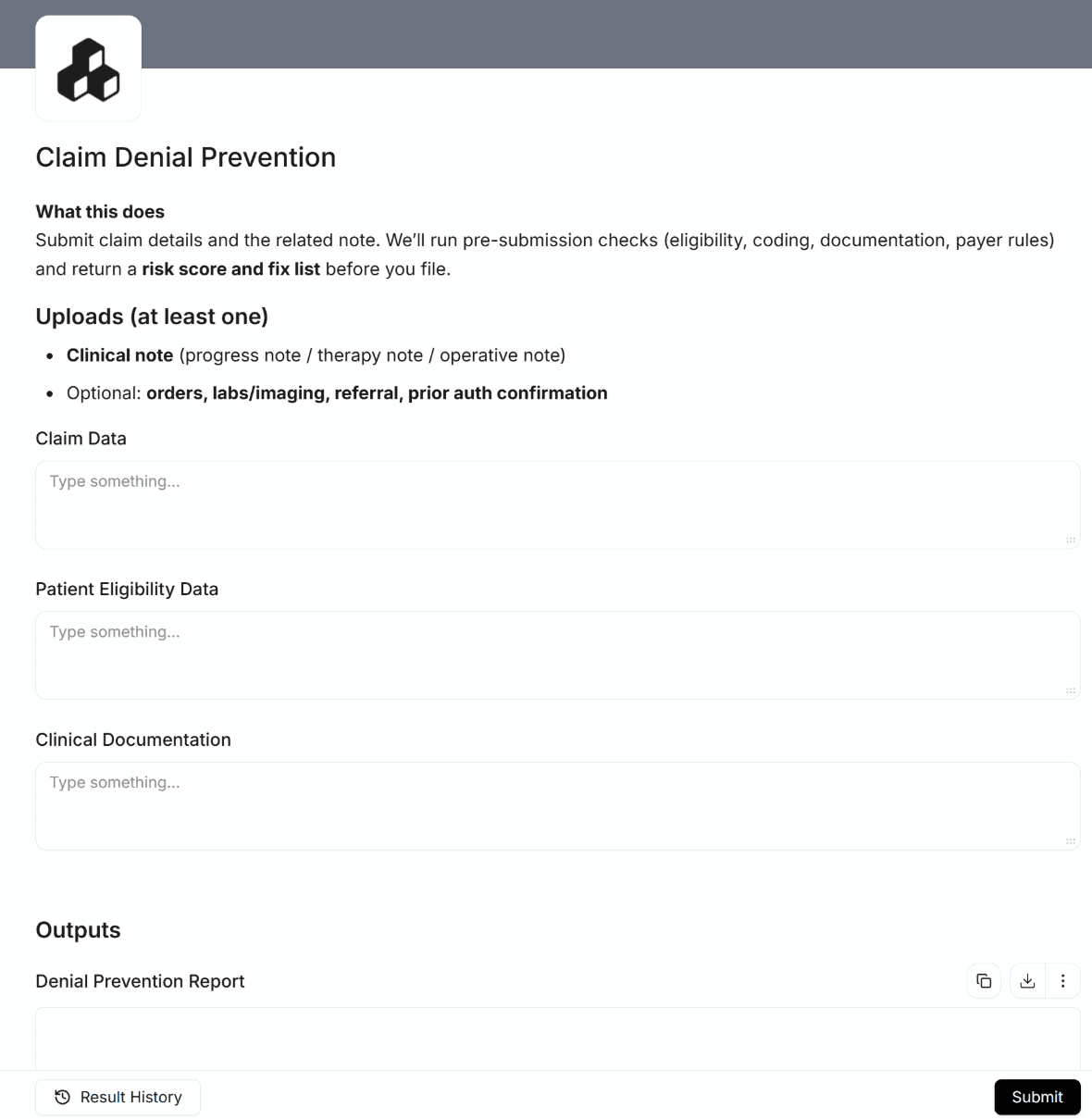
The surface billers use: submit claim data and the note, get a risk score and fix list back before filling.
A clinical note is checked against payer-specific documentation requirements and returns a compliance score, a pass-or-fail determination, and specific fixes with example language the clinician can use.
StackAI - workflow canvas

The build: the note plus claim metadata feed a compliance reviewer that produce a structured report.
app.stackai.com

The surface: check a note before you bill, in about ten seconds, and catch what would deny sixty days later.
Two financial statements are compared into a side-by-side balance-sheet table, with a summary of the material differences and a drafted email of the findings ready to send.
StackAI - template

The build: upload two statements, extract and compare the sections, then summarize and route the differences.
"How do I know it will not code something wrong or file a bad claim?"
"So is this fully autonomous, or not?"
"Our denials live in Availity and payer portals. Can it reach them?"
"Can it stand up to a payer audit?"
"How do we prove ROl before committing?"
Eligibility and coverage capture stop denials at the cheapest point to stop them, the front door.
Documentation compliance stops the next tier of denials before claims ever go out.
Denial analysis and closed-loop processing recover the denials that still happen, and feed every resolution back into the knowledge base so the system gets smarter.
Post-visit reporting protects the reimbursement that depends on accurate, timely filing.
Each layer reduces the load on the next, and the approvals feeding back into the knowledge base are what let autonomy safely expand over time.

Citations, evaluator scoring, and measured accuracy before autonomy, not confident guessing.
Recommend, approve, then auto-execute on eligible codes, with the threshold under your control.
Agents run on your denial history and payer rules, and improve as approvals feed back in.
API and browser automation into Availity, payer portals, and clearinghouse feeds
Every decision logged, explainable, and exportable for payer audit and compliance.
Flat monthly subscription with ROI proven on your own denial and documentation volumes.