stackai whitepaper
AI Agents for Digital Health and Virtual Care
How virtual-first providers, digital health platforms, and care-management companies are deploying AI agents to grow their patient panel without growing headcount.
A practical guide for CIOs, COOs, CFOs, and Heads of Clinical Operations evaluating AI agent platforms in virtual care.





Digital health and virtual care companies were built on the promise that technology could make care more accessible, more convenient, and more affordable. AI agents are the next layer of that promise: operational infrastructure that lets a 200-person company serve the patient volume that used to require 350.
This whitepaper consolidates StackAI's deployment learnings across virtual-first providers, behavioral health platforms, telehealth, and digital MSK into five production use cases: patient message classification and draft-reply, voice and live-chat patient assistance, intelligent intake and eligibility, message and call quality monitoring, and cancellations and retention.
At scale these run in production. On a single national telehealth deployment, the messaging stack alone runs well over 350,000 draft classifications and 380,000 intent- routing decisions per quarter, the patient-summary service backing every agent runs roughly 667,000 lookups per quarter, and the QA layer grades more than 440,000 interactions per quarter. Companies running these workflows report 25 to 35 percent reductions in cost per active patient per month, 15 to 20 point improvements in intake completion, 40 to 60 percent deflection of inbound support volume, near-total audit coverage of patient communications, and notes-compliance rates above 96 percent.
The companies that operationalize this first will serve more patients, in more states, across more conditions, with the same team. In a market where acquisition costs are rising and reimbursement is tightening, that operational leverage is what separates the companies that scale from the ones that stay small.
380K+
Intent-routing decisions / quarter
667K
Patient-summary lookups / quarter
440K+
Interactions QA-graded / quarter
25-35%
Lower cost per active patient
Digital health companies face a contradiction that brick-and-mortar practices never had to confront so starkly: the entire value proposition is that technology makes care delivery more efficient, but behind the sleek patient app, operations often look remarkably manual.
A behavioral health platform might have 50,000 active patients. A telehealth provider might handle 30,000 visits a month. A digital MSK program might be embedded in a dozen employer contracts. In every case the business model rests on one ratio: cost per active patient per month. And that ratio is under constant pressure.
Clinical staff are an inherently constrained resource. But you can remove the operational friction that eats into their patient-facing time, and you can automate the administrative work that currently requires human judgment only because no one has built the system to handle it autonomously.
That is where AI agents come in, as operational infrastructure that lets a smaller team serve a larger panel.
The KPIs that define success
The metrics that matter here are precise: cost per active patient per month, time-to- resolution, ticket deflection rate, provider minutes saved, intake completion rate, and churn. Every use case in this whitepaper maps to one or more of them.
Multi-state complexity
A company operating in 40 states faces 40 sets of telehealth regulations, consent requirements, and scope-of-practice rules. Agents need to be configurable per jurisdiction, not just per organization.
Flexible architecture
Virtual care runs on a stack of SaaS tools: telehealth platform, separate EHR, CRM, engagement platform, billing. Agents need API and integration depth to orchestrate across that stack rather than assuming an EHR-centric workflow.
Speed of iteration
Digital health ships product weekly, not annually. The platform must support new intake questions, updated compliance rules, and revised escalation criteria without an engineering cycle for each change.
Patient experience as product
In virtual care the patient experience is the product. Every Al-mediated interaction is a product touchpoint, so the bar for tone, quality, and accuracy is materially higher than in back-office automation.
Data as a strategic asset
Virtual care generates rich longitudinal data. Agents that leverage it (spotting engagement patterns, predicting churn, optimizing provider matching) compound in value over time.
Classifies every inbound message, drafts a tone- matched clinical reply for the rep or provider to approve, and grades the result.
Resolves the majority of inbound patient conversations autonomously across chat and voice, with intelligent escalation to the care team.
Orchestrates identity, eligibility, clinical screening, consent, and provider matching as one adaptive conversation.
Near-total audit coverage of every patient interaction against HIPAA, state telehealth rules, scope-of-practice, and internal quality standards.
Intercepts churn signals, offers evidence-based retention paths, and orchestrates the between-visit lifecycle.
The Problem
For a virtual-first provider, the message is the front door to care. Patients ask about scheduling, symptoms, medications, side effects, refills, insurance, and program questions, all day, at a volume that overwhelms human teams. Response times slip from minutes to hours to days, and every slow reply is a churn risk. Doing this well means getting the intent right, pulling accurate patient context, and replying in a clinically appropriate, on-tone voice, thousands of times a day.
How An AI Agent Handles It
The stack has three layers that share one patient-summary object:
– A classifier reads every inbound portal message and routes it (provider queue, MSR queue, refill, cancellation, billing, escalation, auto-response). It is trained on the customer's own message history and continuously re-tuned against QA-graded outcomes.
– A draft-reply agent pulls the patient's full context, retrieves the SME-approved answer or protocol from the knowledge base, and writes a reply for the rep or provider to review and send. Separate flows exist for weight-management, women's health, renewals, and providers, each with its own tone rules and clinical guardrails.
– A QA agent grades the interaction so the loop improves over time.
Why It Matters
In subscription virtual care, churn correlates strongly with responsiveness. The classifier is the single most-invoked workflow in a mature deployment (roughly 380,000 routing decisions per quarter on one national provider), and the draft-reply layer runs even higher. Getting the intent right and the first draft written is what lets the human team clear the queue instead of drowning in it.
Director of Patient Support, VP Clinical Operations, Head of Member Services
Median response time, messages handled per rep, first-contact resolution, CSAT, churn
Hours to seconds on the routed tier, human queue shrinks so remaining messages resolve faster, tone and clinical accuracy held constant at volume
The Problem
Patient engagement matters, and patients do not keep business hours. A growing share of inbound volume (scheduling, program information, refills, general questions) does not need a clinician at all, but it still lands in a human queue.
How An AI Agent Handles It
A production voice- and chat-enabled assistant handles inbound conversations with tool-calling access to the patient record, provider availability, and program-eligibility rules. It goes beyond a scripted FAQ bot: it understands multi-issue messages, queries live systems for specific answers, triages clinical concerns to the care team with a structured summary, and operates around the clock. The architecture uses subflow tools, so the same chat agent can call scheduling, eligibility, and knowledge-base subflows without one monolithic prompt. Voice calls are post-processed into structured intent and summary records for QA and analytics. A flagship live-chat surface runs roughly 20,000 production sessions per quarter.
Why It Matters
A patient who waits 18 hours for a simple answer is far more likely to disengage than one who gets an accurate answer in 30 seconds. The agent protects revenue as well as cost, and it shrinks the human queue so the remaining tickets resolve faster too.
Director of Patient Support, VP Operations, Head of Member Services
Ticket deflection rate, median response time, CSAT, churn
0 to 15 percent deflection becomes 40 to 60 percent, 24/7 coverage, faster resolution on the human-handled tier
The Problem
Virtual onboarding is more involved than it looks: identity verification across a digital channel, eligibility checking across many payers and plan types, clinical screening that varies by specialty (PHQ-9, GAD-7, medications, allergies), telehealth and HIPAA consents, provider matching on clinical need, availability, licensure, and language, and first-appointment scheduling that accounts for all of it. In most companies this touches three to five systems, takes 15 to 30 minutes of staff time per patient, and completes well below 100 percent. Every patient who starts intake but does not finish is a lost acquisition.
How An AI Agent Handles It
The agent runs intake as one adaptive conversation: it collects demographics and insurance conversationally, verifies eligibility in real time, administers screening instruments and branches on the responses, presents consents in plain language, matches the patient to a provider, and offers scheduling. A companion clinical-eligibility validator checks each consult against program rules (contraindications, interactions, age or BMI thresholds, state prescribing restrictions) and returns a pass, flag, or hold with the specific rule cited. And when a patient uploads an insurance card or a paper intake form, an OCR-plus-extraction step returns a structured coverage record (payer, member ID, group, plan, copay) written straight to the chart, cutting the "wrong insurance on file" errors that drive denials weeks later.
Why It Matters
Intake completion is one of the most leveraged metrics in digital health. A 10-point improvement on 5,000 monthly starts is 500 additional patients entering care with zero additional marketing spend.
VP Patient Experience, Director of Operations, Director of Patient Acquisition
Intake completion rate, time-to-first-appointment, cost per completed intake, clean- insurance rate
65 to 75 percent completion becomes 80 to 90 percent, 5 to 10 day time-to-first- appointment becomes 1 to 3 days, staff time per intake cut by more than half
The Problem
Support teams (care navigators, patient success, coaches) handle inbound and outbound communications subject to HIPAA, state telehealth rules, and internal quality standards. Manual QA typically covers 2 to 5 percent of interactions, which means 95 percent-plus go unreviewed. For a company handling 30,000 interactions a month across multiple regulatory regimes, that unreviewed volume is existential risk.
How An AI Agent Handles It
An agent reviews every interaction (call transcript, chat log, message thread) against a structured rubric: HIPAA identity verification and minimum-necessary standards, scope-of-practice and state consent requirements, protocol and script adherence, resolution, tone, and escalation appropriateness, plus sentiment and safety-signal detection. Results are scored, rolled up by rep, team, program, and channel, and flagged for human review when issues surface. On a mature deployment this grades more than 440,000 interactions per quarter, up from a sampled few percent.
Why It Matters
Automated monitoring turns QA from a periodic spot-check into a continuous, audit-ready trail, at a cost that scales sub-linearly with volume. For a multi-state operator, that coverage directly reduces regulatory tail risk.
Compliance Director, VP Customer Operations, QA leads, Head of Clinical Operations
Percent of interactions audited, issue-detection rate, escalation accuracy, multi- state exposure
2 to 5 percent coverage becomes near-total, earlier detection of systemic issues, audit-ready trail per interaction
The Problem
Patient drop-off quietly erodes virtual care unit economics. A patient who enrolls, has two sessions, and disappears consumed onboarding cost without generating enough lifetime value to cover acquisition. The between-visit lifecycle (assessments, refills, adherence nudges, transitions, re- engagement) works at 5,000 patients and breaks at 50,000.
How An AI Agent Handles It
A cancellation agent intercepts inbound cancellation requests, classifies the reason (cost, side effects, no longer needed, switching, clinical concern), pulls the patient's full history, and either offers an evidence-based retention path (pause, plan change, provider swap, coupon) or routes to a specialist with the case pre-summarized. For clinically sensitive cases (adverse events, protocol failures) it escalates straight to a clinical reviewer rather than trying to retain. A companion flow orchestrates the rest of the lifecycle: post-visit summaries reinforcing instructions, between-session monitoring of patient-reported data with threshold alerts, transition summaries, and multi-step re- engagement when disengagement signals appear.
Why It Matters
Automated flow orchestration protects the business model directly and frees coordinator capacity for the high-touch cases where human attention changes outcomes.
Retention leads, care managers, telehealth operations teams
Retention lift, adherence, follow-up completion, churn, lifetime value
Measurable retention lift with clinical guardrails intact, earlier detection of disengagement, coordinator capacity recovered
Set It in Production
Four of these workflows, built and running on StackAI today.
An intent classifier reads each inbound patient message, detects urgent red flags, and routes to an urgent or routine handler, with every interaction written to a HIPAA audit log before the patient response goes out.
StackAI - workflow canvas

The build: triage and classification route each message to the right handler, grounded in payer and clinical knowledge bases.
An intake orchestrator runs eligibility, provider matching, and scheduling as subflow tools, turning a patient's first message into a structured, routed intake.
StackAI - workflow canvas
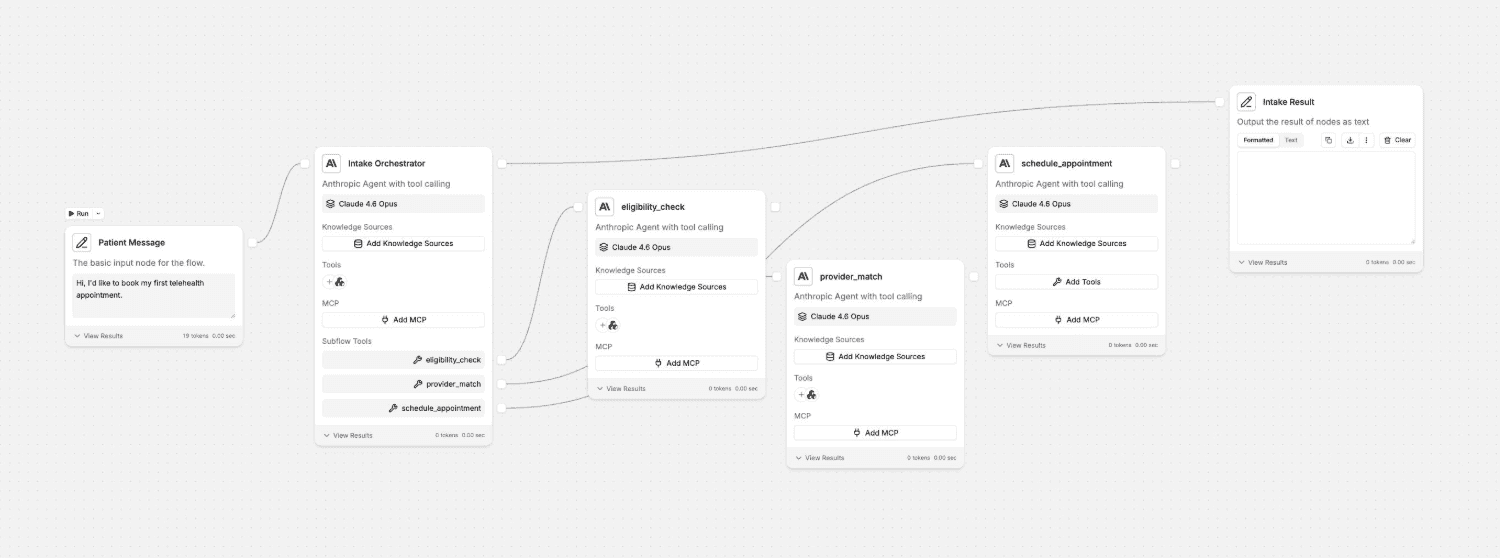
The build: one orchestrator calls eligibility, provider-match, and scheduling subflows from a single conversation.
Call transcripts are analyzed against a compliance rulebook, producing a QA summary, a pass-or- fail status, a Teams alert on non-compliant calls, and a full compliance report.
StackAI - workflow canvas

The build: transcripts and metadata feed a compliance and analyzer and QA summary, then route alerts and a report.
An orchestrator with a safety router coordinates post-session summaries, between-session monitoring, transitions, re-engagement, and crisis escalation across the patient lifecycle.
StackAI - workflow canvas

The build: webhooks and scheduled crons drive monitoring, transition, re-engagement, and crisis-escalation subflows.
"Are you HIPAA compliant, and is our PHI safe?"
"We run on a telehealth platform plus a separate EHR. Can you integrate?"
"How do we stop it from getting a clinical answer wrong?"
"Why not just use Copilot or build it ourselves?"
"How is it priced, and how do we know it pays off?"
Quality and compliance monitoring is the foundation that lets you deploy other agents
confidently in a regulated, multi-state environment.
The messaging stack and the voice or chat assistant absorb inbound volume without
growing the team, keeping cost per patient in check as the panel scales and feeding a
richer signal to the monitoring layer.
Better intake means more patients enter care with clean data, correct insurance, and
appropriate provider matches, which reduces downstream billing issues and improves
show rates.
Cancellations and flow orchestration keep patients engaged between visits, which
improves retention and lifetime value, and feeds the next cycle of clean intake, clean
documentation, and clean compliance.
Together these address the core challenge of a scale-up: growing the panel from 10,000 to 100,000 without growing the team from 100 to 1,000.


Citations, evaluator scoring, and measured accuracy before autonomy, not confident guessing.
500+ integrations including leading EHRs, telehealth platforms, CRMs, billing systems, and engagement tools, the SaaS stack virtual care runs on.
Handles PDFs, scans, images, and audio natively, critical for transferred records, intake forms, and insurance cards.
Clinical ops, RCM, and compliance experts build and modify agents in days. New intake questions and rules do not need an engineering ticket.
Review, approval, and escalation on every clinical and revenue workflow, with full audit logging for regulatory readiness.
No LLM lock-in, automatic fallback, plus access control, audit logs, and role-based permissions built in.