StackAI is excited to announce the launch of Multi-Agent Teams: an Orchestration system to assign distinct roles to Sub-agents and delegates work across them. Instead of overloading one language model with every task, you build a team of specialized agents to produce sharper, more accurate outputs than one LLM ever could.
Key Takeaways
Delegate instead of overload. An Orchestrator system calls other Sub-agents, to handle each specialized use case and reduce overloading the main LLM.
Specialists beat generalists. Each sub-agent works from a narrow scope: its own instructions, its own knowledge sources, and only the tools its job requires. Less to reason across means fewer wrong turns and more accurate output.
Work runs in parallel. The orchestrator routes each job to the right specialist and runs them simultaneously, so a task that used to take multiple sequential passes only takes one.
Why One LLM Shouldn’t Do Everything
Most teams build their first agent, then keep adding to it: a tool, an integration, a knowledge base, twelve more lines of edge-case handling. Six weeks later it is one model holding thirty tools and a two-page prompt, and quality has quietly gotten worse.
That is a structural issue, not a prompting problem. Every tool you attach widens the decision space the model reasons across on every call, and every instruction competes with the ones already there. Asking one model to be a support rep, a data analyst, and a compliance reviewer at once does not make it versatile. It makes it worse at all three.
Enterprises solved this problem structurally. Rather than assigning one person every responsibility, they hire specialists and coordinate them through a manager. StackAI’s Multi-Agent Teams bring that same structure to your AI workflows.
How It Works
A Multi-Agent Team runs the way a well-structured team does: a manager takes the request, assigns the pieces to the right members, and pulls the results back together. In StackAI, that manager is an Orchestrator LLM agent, and the team members are LLM Sub-agents.
Step 1: Task management. The Orchestration system receives a complex request, breaks it into its component jobs, and determines which Sub-agents are needed for each.
Step 2: Specialized execution. Each Sub-agent runs its own workflow using its own instructions, tools, and knowledge bases, then returns finished work to the orchestrator.
Step 3: Synthesis. The Orchestration system combines what comes back into a single output and routes it wherever it needs to go: a chat response, an email, a comment on a ticket, or a row in your system of record.
Building one takes a few clicks. In the StackAI platform, go to Core Nodes → AI Agent → select an AI provider → Sub Flow Tools → + Add Sub Flow Tool. Sub-agents attach to the Orchestrator as Sub Flow Tools, which means any workflow you have already built can become a specialist on a team, and you can add as many as you need.
In-Depth Use Case: The SEO Performance Monitoring Agent
Imagine you are an SEO manager on the marketing team, tasked with pulling accurate performance metrics for a weekly status update. Here is that job rebuilt with StackAI's Multi-Agent Teams.
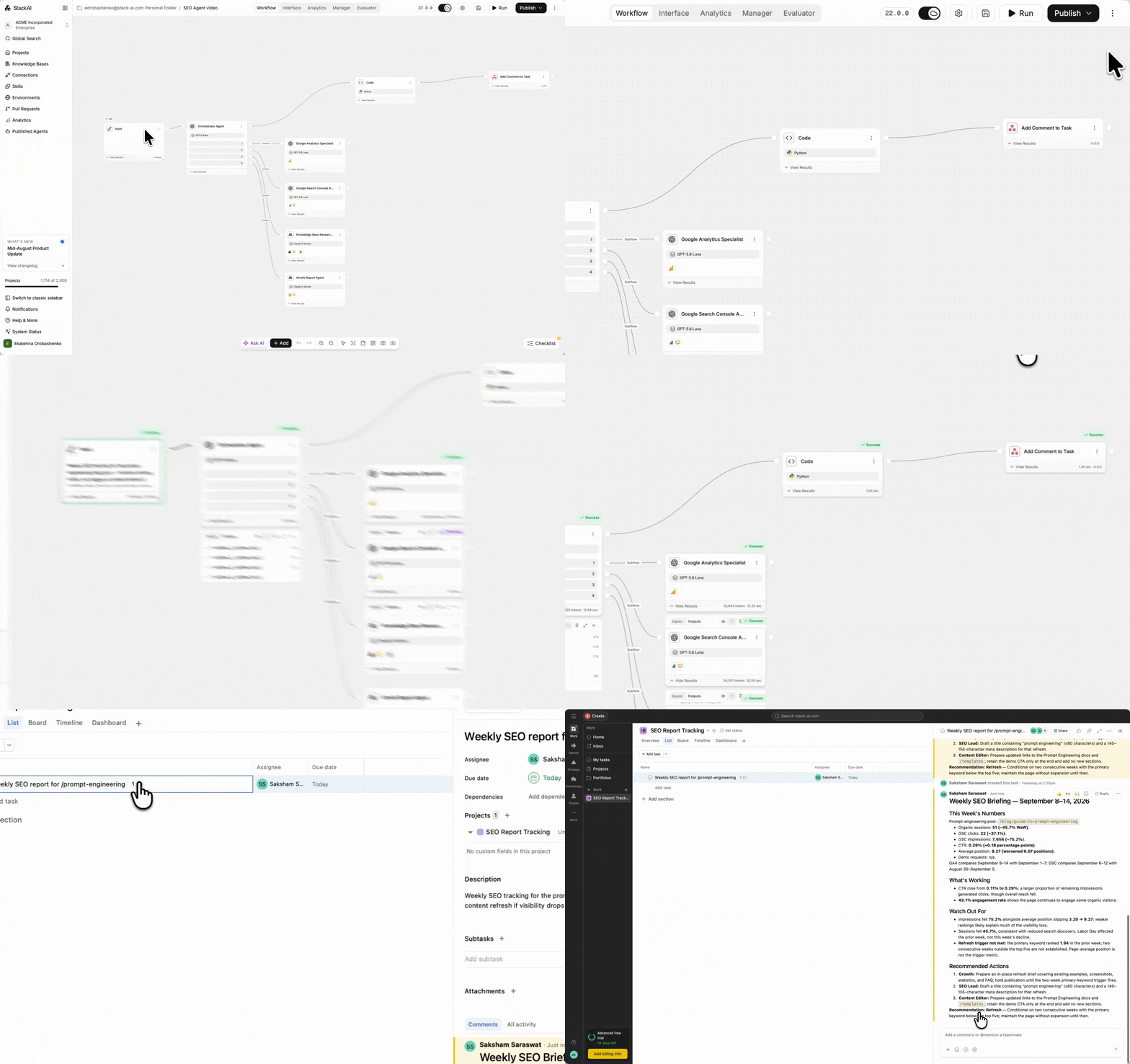
"Write the weekly SEO report" sounds like one job, but it really involves multiple role functions. A text input node takes the request and passes it to the SEO Performance Orchestrator, an LLM agent running GPT Astra 6, which coordinates four specialists:
Google Analytics Specialist for traffic, pageviews, and user behavior
Google Search Console Analyst for rankings, clicks, and impressions
Ahrefs Report Agent for backlinks and competitive positioning
Knowledge Base Researcher for strategic context and historical performance
The orchestrator calls the relevant specialists in parallel, then consolidates their findings into a single briefing. Four separate data pulls collapse into one run, each specialist stays expert in one surface, and the marketing team gets accurate SEO metrics in a fraction of the time.
Get Started with Multi-Agent Teams
The most valuable work in any organization happens across teams, not inside a single role. Multi-Agent Teams bring that structure to your AI workflows: an Orchestration system that assigns and coordinates, Sub-agent specialists that execute within a defined scope, and output you can trace back to the agent that produced it. The result is not just a faster workflow, but one that scales the way your organization already does, by adding expertise, not by asking one model to absorb more.
Want to see how leading companies are saving thousands of hours with no-code AI agents on StackAI? Book a demo with our team here.

Esther Na
Product Marketing at StackAI